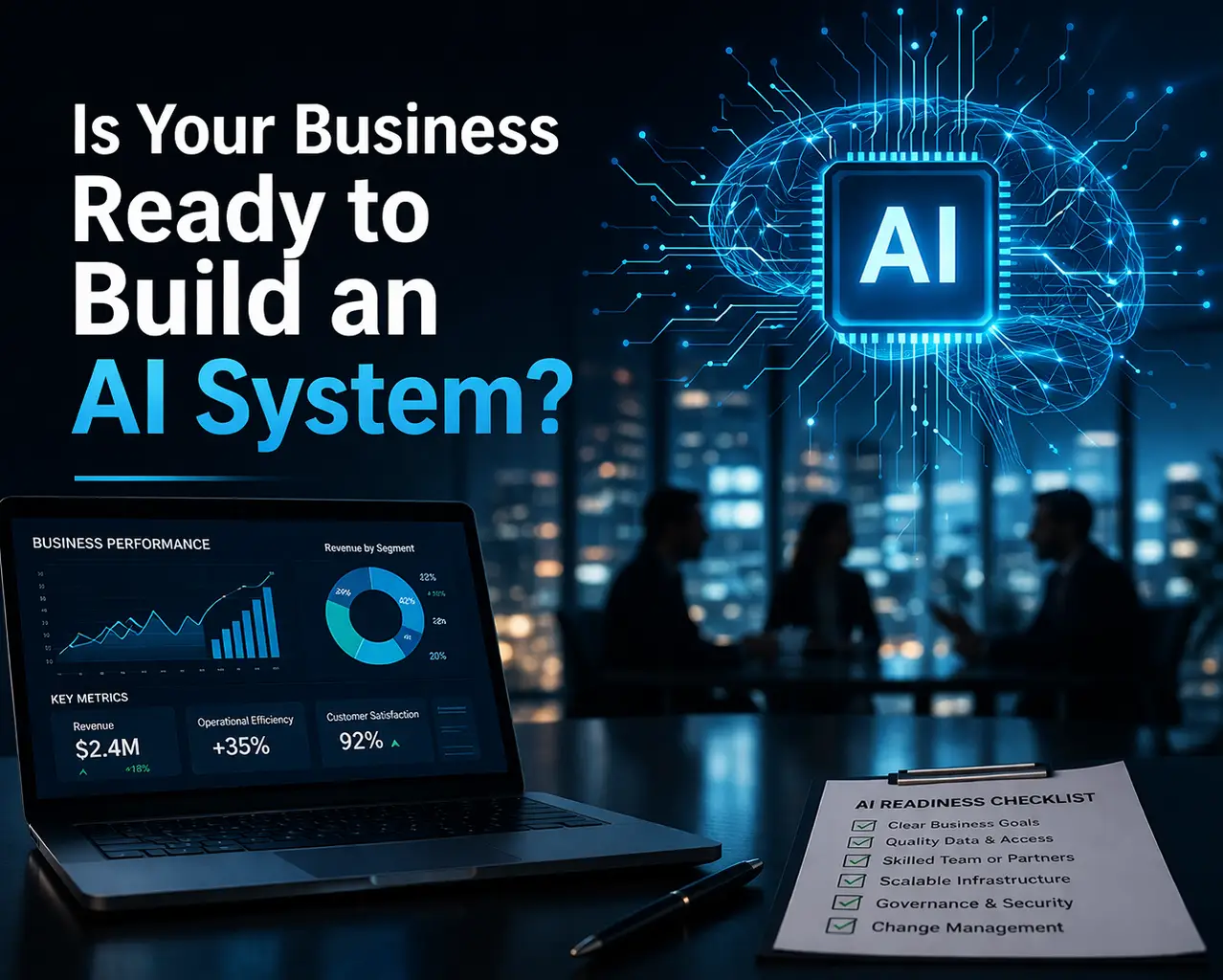
Most AI projects don’t fail in development. They fail before it starts — because the business wasn’t ready.
That’s not a warning about technology. It’s a warning about assumptions. Companies invest in an AI build expecting the technology to sort out the underlying problems: messy data, undefined processes, misaligned leadership. It doesn’t. The technology amplifies what’s already there — which means if the foundation is weak, the system will be too.
Before you scope a build, brief an agency, or allocate a budget, there are five questions worth sitting with honestly. Your answers will tell you more about your AI readiness than any vendor pitch.
1. Is your data actually usable?
This is where most AI initiatives quietly break down. The assumption going in is usually: “we have data.” The reality, discovered mid-project, is that the data is scattered across tools, inconsistently formatted, partially incomplete, and not accessible programmatically.
An AI system is only as good as the data it runs on. Before any build, you need honest answers to three things:
- Is your data centralised, or spread across spreadsheets, CRMs, and disconnected SaaS tools?
- Can it be accessed via API or export — or is it locked inside platforms that don’t talk to each other?
- How much usable history do you have? AI systems that learn from patterns need enough historical data to find them.
None of these are blockers if you know about them in advance. They become expensive problems when they surface mid-development.
The fix is almost never technical. It’s operational — getting the right data into the right structure before the build begins, not during it.
2. Are your processes documented well enough to automate?
AI automates processes. It doesn’t design them. If the workflow you want to automate lives primarily in the heads of two or three people — or changes depending on who’s handling it that day — you don’t yet have something an AI system can reliably replicate.
The businesses that get the most from AI builds are the ones that had already done the hard work of documenting how things work: what triggers a process, what decisions get made along the way, what a good outcome looks like, and how exceptions are handled.
If your answer to “how do you handle X?” is “it depends” without a clear framework, that’s a signal to document first and build second. The documentation work is faster than you think — and it pays for itself many times over during the build.
3. Does your team have an internal owner for this?
AI projects without an accountable internal champion tend to drift. The vendor builds what was specified. The business moves on to other priorities. Six months later, the system isn’t being used the way it was designed — or isn’t being used at all.
Every successful AI build we’ve seen has had one thing in common: a single person internally who owned the outcomes. Not just sponsored the project from leadership — but actively engaged with how the system was being built, held the team accountable to the use case, and took responsibility for adoption after launch.
That person doesn’t need to be technical. They need to be invested. Before you start a build, identify who that person is and what authority they have.
4. Is your technology stack ready to integrate?
An AI system doesn’t exist in isolation. It reads data from somewhere, writes outputs somewhere, and usually sits inside an existing product or workflow. How clean that integration is depends almost entirely on the state of the technology it needs to connect to.
Legacy systems — custom-built platforms from five or more years ago, tools with no APIs, infrastructure that was never designed to be extended — create integration complexity that can double the scope of a build. Not because the AI work is harder, but because getting data in and out becomes its own project.
A brief technical audit before scoping will tell you exactly what you’re working with. Most agencies won’t raise this in a sales conversation. It’s worth asking about directly.
5. Is leadership aligned on what success looks like?
This one gets skipped because it feels soft. It isn’t. Misalignment at leadership level is the single most common cause of scope changes mid-build — and scope changes mid-build are where projects get expensive.
“Leadership supports AI” is not the same as leadership having agreed on a specific outcome, a measurable success metric, a realistic timeline, and who owns the decision if the project needs to pivot. The former is a mood. The latter is a foundation.
Before a build starts, it’s worth running a brief internal alignment exercise: what exactly are we building, what does it need to do for us to consider it a success, who owns it, and what happens if it underperforms? The answers should be written down and agreed on before any external vendor is involved.
What this looks like in practice
These five dimensions — data, process, team, technology, and organisational alignment — are the same dimensions that determine whether an AI build delivers on its potential or becomes a cautionary tale. They’re not equally weighted for every company. Some organisations have exceptional data and fragile processes. Others have strong alignment but creaky infrastructure.
The value of assessing readiness before building isn’t to find reasons not to proceed. It’s to understand where the risks are concentrated — so they can be addressed in the right order, with the right investment, before they show up as surprises on a project timeline.
If you’re seriously evaluating an AI build, the most useful thing you can do before talking to any vendor is understand your own starting point.
Take the assessment
We built a free AI Readiness Assessment that scores your business across all five dimensions in about three minutes. No sign-up required. You’ll get a radar chart of your readiness profile and a specific insight for whichever dimension is most likely to cause problems.
It won’t tell you whether to build. It will tell you what to think about before you do.
→ Take the Free AI Readiness Assessment — beyondt.in/tools/ai-readiness-assessment
If your results surface something you’d like to talk through, we’re available for a free 30-minute scoping call. No pitch — just a straightforward conversation about what an AI build would realistically look like for your situation.
Beyondt Consultancy & Services Pvt Ltd · beyondt.in
ARTICLE 2 OF 2 · Brand Website Development
SEO Metadata
Title tag: Why Your Website Is Losing You Deals You’ll Never Know About
Meta desc: Your B2B website is evaluated in your sales conversations whether you invite it or not. Here’s how to diagnose the gap between your actual business quality and the signal your site is sending.
Primary kw: B2B website credibility
Secondary kw: does my website match my brand, business website not converting, website brand fit
Word count: ~1,400 wordsCTA: beyondt.in/tools/brand-website-checker